
Saturday, January 20, 2018

Review: Call Me By Your Name


Do you remember falling in love for the first time? Those intense, almost electric feelings brewing inside while stare at your crush? Or the fluttering, ecstatic energy that rushes through you with each accidental touch? Regardless of how long it’s been since you’ve had them, these memories flood back while watching Call Me By Your Name.

The film focuses on the relationship between Elio, a 17-year-old living in Northern Italy with his highly academic, free-spirited family, and Oliver, the 24-year-old doctoral student who is the guest of Elio’s family for 6 weeks in the summer of 1983. Though Elio is initially put off by Oliver’s presence, his attraction to the guest grows into something more complex than simple teenage infatuation. What follows is a relationship told in scenic bike rides and swimming at the lake, through secret notes and midnight meetings. It’s these small moments, the brushing of hands or the stolen glances, that make the movie so much more than a typical gay romance, but rather the story of two people falling in love.

This film is about a teenagers first, real feelings of love while also navigating the relatable coming-of-age issues of friendships, sex, loneliness, and rejection. For anyone who remembers their first feelings of love- especially those of us who have ever had a closeted romance - you’re sure to remember the small, public moments where you hold a finger or two for a brief second, but you know that is exactly where your hand belongs.

Call Me By Your Name challenges the audience to focus on the relationship of the characters rather than their sexuality, proving that first love is a universal experience. While that is an impressive plot for a film to begin with, the stellar cast of Elio’s family and friends drives it home.This film will take you back to your adolescence, to a time where the summer was for endless possibilities, regardless of the clock ticking down to reality. You’ll remember your first love, summers spent with your friends, the lazy days reading books. Experience the love, friendship, laziness, joy, and all the feelings in between wrapped up in this beautiful summer romance. It’s a peach!

Saturday, December 9, 2017

Review: Three Billboards Outside Ebbing, Missouri

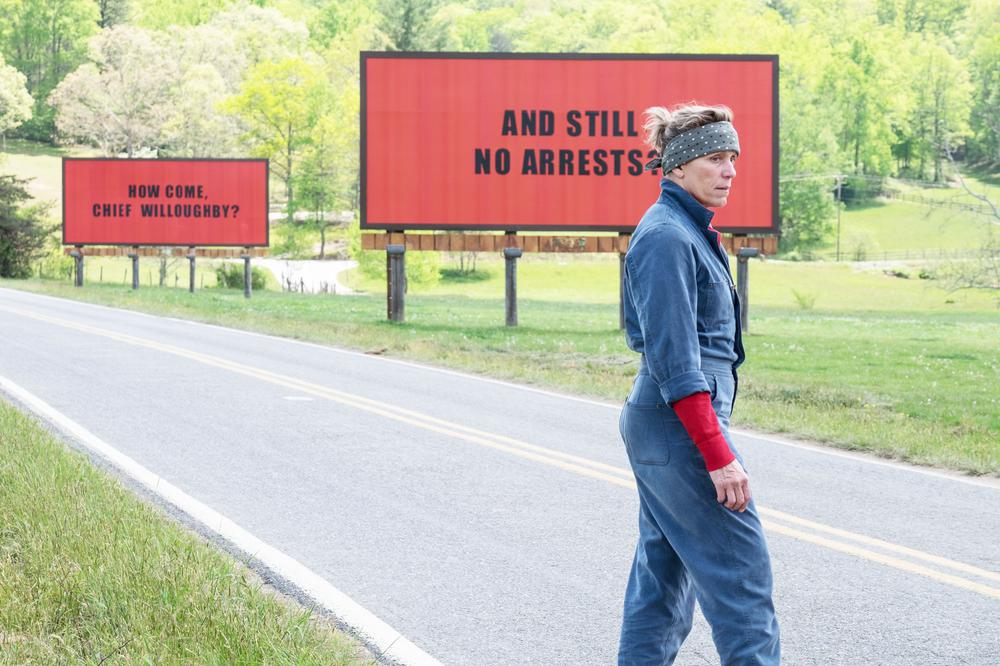
As viewers delve into Martin McDonagh’s fourth feature, a grim and saddening world is revealed. While similar to the dark humor in his previous films, McDonagh builds upon a story which focuses on the hope and drive of main character Mildred Hayes, after her daughter’s murder. Beginning seven months after the crime, the police station of Ebbing, Missouri has grown lethargic in regards to catching the perpetrator. This is what leads Hayes to rent three billboards outside the town, after having been unused for many decades prior. In her words: “The more you keep a case in the public eye, the better your chances are at getting it solved.” These billboards, an eccentric and extreme form of protest, do just that. Mildred’s attempts to disturb the townspeople are effective, leading to a series of torment against her. McDonagh develops this story into that which makes Three Billboards his most human film.

Events throughout the timeline of the story, unpredictable and alarming, present themselves in a sincere and brazen manner. Not in a very long time have I been so emotionally affected by a film, which does not fail to get its point across. Depicting many real-world concerns, such as racism, police-torment, and straightforward insensitivity amongst people, it’s shocking to know it was written eight years ago. McDonagh has created a truly compelling, endearing, and enduring character through Hayes, which is, without a doubt, one of the strongest female characters I have seen in my life. Frances McDormand brings this character to its utmost manifestation, working  marvellously in unison with her fellow actors, while still pushing her role to act against them.

Each character in the story goes through such extreme development, written with such intricacy and focus, that nearly every one possesses a characteristic with which its audience can feel for. McDonagh drags his antagonists through mud puddles before cleaning them and hanging them out to dry, which is what makes them so alluring. In the beginning of the story, you are meant to assume the cops are the villains, he is very clear in that regard. He elaborates on this through many instances where these officers showcase fearful habits, before taking each through a heavy realization. Every person in the script has a very established role, and succeed in giving the audience a different moral through their perspective.


Three Billboards Outside Ebbing, Missouri is a story about grief and human tendencies following happenings of tragedy. Martin Mcdonagh has written a fictional masterpiece, causing those to question how we truly regard narratives. This film speaks truths beyond those which are anticipated, making it my favorite film of the year.

Sunday, September 3, 2017

Review: Swim Team

"When I'm swimming, I feel normal."

That's the first thing we hear from Mikey McQuay, a boy with autism who swims for the Jersey Hammerheads. And so begins director Lara Stolman's documentary, SWIM TEAM, a touching account of the struggles and achievements of a swim team in Perthy Amboy, NJ, comprised of kids with autism. Coach Mike McQuay (the previously mentioned Mikey's father) and his wife, Maria, started the team when they realized how important a skill like swimming can be for those with autism - not only in emergency scenarios, but also to fuel the kids' passion and sense of accomplishment.

The story closely follows three athletes - Mikey, a senior in high school who loves animals and is going to graduate from high school soon; Robbie Justino, a boy who thrives in the water and with leadership but doesn't know yet that he has autism; and Kelvin Truong, who also battles with Tourette's Syndrome -- physical and vocal tics that interfere with his everyday life -- and anger management tied in with the frustration of not being able to control these tics.

The documentary is a beautiful chronicle of these boys' lives. With a condition like autism, it is common for these teenagers to feel like outcasts, but the team brings them together and encourages them that they can achieve what they want to. And not only is the team an encouragement to its teammates, but it is also a source of hope, for the community and for those with similar disorders who strive to push themselves in life.

In many documentaries, it can feel like people are trying to force their personality on the camera; in this case, there is none of that. The teammates of the Jersey Hammerheads have no interest in trying to control the way they end up on screen, and that is the beauty of a story like this: in any other case, we would see projections of who they want to be, but here, with a group of kids with developmental disabilities, we see them for who they are. Stolman is not afraid to show the team's losses alongside their victories - there are mistakes made along the way, and discouragements, but the film makes it clear that this isn't about winning - it's about life.

SWIM TEAM is now playing at Midtown Cinema! Don't miss this heartwarming story!

Sunday, August 20, 2017

Review: Step

"We're making music with our bodies. That's slick!"

So says Blessin Giraldo in Amanda Lipitz's new film, STEP. The documentary follows the "Lethal Ladies" of the Baltimore Leadership School for Young Women, a step team at a school which in its founding year, vowed to get all 120 girls in its class accepted into college. Led by Coach G, the team takes success to new levels, working hard at school and hoping to win the competition at the end of the year before they graduate.

The documentary first begins back in 2015, in a Baltimore shaken by the death of Freddie Gray. With the recent events happening in the US, the documentary could not have inadvertently chosen a more perfect time to be released... As America continues to be weighed down by issues of racism and hate, never has step had more power for these ladies. Step, as the film so adamantly affirms, is about spirit in adversity, pushing forward and being united even if the walls are falling down around you. Whether those walls are a metaphor for what is happening in society, or in the girls' own home, it is a powerful message.

The film introduces 3 students as the focus of the documentary: Blessin Giraldo, Cori Grainger, and Tayla Solomon. Blessin is the charismatic one of the group, though she struggles to believe in herself; Cori is the quiet, earnest girl, hoping to get a full ride to Johns Hopkins University; and Tayla brings the attitude, and is constantly embarrassed by her mother's exuberant presence at step practices.

Despite these insights into the girls' lives, the short length of the documentary prevents us from really delving too deep into their stories -- we see enough about them to feel proud for them as they prepare for competition and college, but it can really only stay at a superficial level. Instead, the film focuses its 84 minutes of screen time on societal themes through these students' journeys, like overcoming adversity and being all that you can be. The film certainly lives up to its feel-good status in this regard. Perhaps with another half hour of content, it could have landed even more.


Nonetheless, STEP is a wonderful film, brief but powerful. Now playing at Midtown Cinema!

Sunday, July 23, 2017

Review: Lost in Paris

LOST IN PARIS: the title suggests a travel movie, but that is the most excitement you would expect. But Fiona Gordon and Dominique Abel have really brought spice to such a simple title. Perhaps it's the chemistry that the writer/director/actor duo has brought to the project: not only are they partners in life, but partners in art and comedy, and it translates to the screen beautifully.

This dynamic duo has created a quaint, awkwardly hilarious film based in physical comedy -- every second will either have you laughing out loud or grinning in delight. The majority of the film takes place in -- you guessed it -- Paris, but with little dialogue, the story proves to be pretty universal, simply depicting a lost traveler, her smitten new acquaintance, and her addled aunt.

Fiona (Fiona Gordon) lives in a blustery, snow-covered village in Canada. Ever since her aunt Martha (Emmanuelle Riva) moved there when she was little, she has wanted to go to Paris. And she finally gets her chance when, about 40 years later, her aunt sends a cry for help in the form of a ragged, trash-soaked letter, worried that she will be put in a nursing home.

Fiona journeys to Paris to help her aunt, but once she gets there, Aunt Martha is nowhere to be found. A fall in the river causes Fiona's backpack to get lost downstream, including her purse and passport. Dom (Dominique Abel), an earnest homeless man with a tendency for lucky circumstances, finds her backpack, and -- after spending Fiona's money and wearing her clothes -- decides to help the poor woman find her aunt. Meanwhile, Aunt Martha is wandering the streets of Paris and stirring up trouble.


With vibrant colors and comical insight into everyday mundanity, the beauty of LOST IN PARIS is that we get to know these characters with so little dialogue. While Fiona does know some French, the language barrier provides a fresh canvas for a uniquely awkward humor -- though we're hardly able to classify it as slapstick, it is ingrained in the movement of the characters. Don't miss this hilarious film! Now playing at Midtown Cinema.

Sunday, July 2, 2017

Review: Beatriz at Dinner

Director Miguel Areteta and writer Mike White each have an arsenal full of comedies -- Mike White's works include NACHO LIBRE and SCHOOL OF ROCK, while Areteta somehow furthered his career with comedies after YOUTH IN REVOLT -- but when the two combine, an uncomfortably candid drama unfolds.Though not without its scattering of darkly comedic moments, BEATRIZ AT DINNER is a formidable satirization of the current ambience of political affairs involving immigration issues.

Beatriz (Salma Hayek) is a healer -- soft voice, house full of meaningful trinkets, always seeing the spiritual side of things. She has pet goats.

As the introduction of the film sinks us into her character, Beatriz weaves her way through an opposing worldview, opening a window of spirituality in the lavish home of the elites who pay for her services. One such family is that of Cathy and Grant (Connie Britton and David Warshofsky), whose daughter Beatriz previously worked with to get her through the stages of cancer.

While it is clear that Cathy and Grant grateful for Beatriz's services, the choices they make in their "harmless" but telling dialogue reveal that they value their lifestyle and image more than Beatriz's actual company. When Beatriz's car breaks down in their driveway, Cathy invites her to stay for a dinner they are hosting, and later to spend the night -- an invitation she extends in front of her moneyed peers, of course, who recognize the action as charitable. Here, Beatriz's friendship is convenient -- but that is a facade that will not last the night.

Enter Doug Strutt (John Lithgow). Mr. Strutt is a business executive -- white, male, and abusing his privilege, he hunts animals for enjoyment and has little concern for the welfare of others if it means making an extra buck. His new hotel - the raising of which is the reason behind the dinner - has attracted protestors, and so begins the conversation that triggers a fiery relationship between him and Beatriz, fueled by the haunting of Beatriz's past and an unavoidable butting of heads between two dominant personalities.

The film very expressly makes a statement, not only about prejudices -- the conflicting cultures are so beautifully etched out, and Beatriz's anger at the actions that Mr. Strutt takes is visceral -- but also about the struggle that many minorities find in feeling a sense of belonging. From her position at the peripheral, Beatriz fights hard to find her center. Havek gives a moving performance, balanced well by Lithgow's slimeball affect.


BEATRIZ AT DINNER is now playing at Midtown Cinema! Don't miss this one.

Monday, June 12, 2017

Review: It Comes at Night

If you don't know much about IT COMES AT NIGHT, good. Keep it that way. Watch the film.

The less you know, the better it is, because it's all about the unknown. I will tell you a bit about the plot just to tease you into watching: in a forest in the middle of nowhere, a family has lodged themselves inside their home to avoid a sickness that has struck the outside world. Paul (Joel Edgerton) has built a very structured living situation for his wife, Sarah (Carmen Ejogo) and son, Travis (Kelvin Harrison, Jr.). They board all the windows and doors, only go outside in pairs, and always wear gloves and gas masks when they are outside. They have to do this to remain safe, and keep the sickness out of their home. Then they discover another family living out in the forest, and decide to let them in.

And that's all you get... because to truly appreciate this psychological thriller, you only need to know as much as the characters know. In fact, the film will leave you with a lot of questions -- but that is what makes it such a thought-provoking, upsetting film. It's a story that guarantees to spark conversation, after you process the dark, vividly honest nature of what you just watched.


Every frame of the film beautifully crafts the experience of Travis, who serves as our eyes throughout the majority of the film. It's really one big character sketch, as the family tries to make a life for themselves and bond with each other. 

From the writing to the acting to the decisions behind each shot, IT COMES AT NIGHT will move you. Now playing at Midtown Cinema! Don't miss this film!